
The Royal Commonwealth Society ACT and the Australia–Britain Society held their 2026 Spring Luncheon at the Royal Canberra Golf Club on Sunday 1 November. Guest speaker Honorary Professor David Plummer AM addressed The Curious Case of Boys’ Education in the Commonwealth, examining changing patterns of educational participation in the Caribbean and the Pacific.
Trinidad Carnival. Photograph by David Plummer.
Report based on a summary supplied by David Plummer AM.
Changing patterns of participation
Professor Plummer explained that gender equity is a regular component of international development projects. Traditionally, gender analysis has sought to ensure that the roles and interests of women are recognised and promoted. His presentation considered emerging inequalities affecting boys and young men, drawing on evidence of a sustained decline in their engagement with education across a range of Commonwealth settings.
Drawing on research by Rhoda Reddock and Barry Chevannes, he noted that girls had become the majority of secondary school enrolments in the Caribbean, with higher attendance and retention rates than boys across age groups.
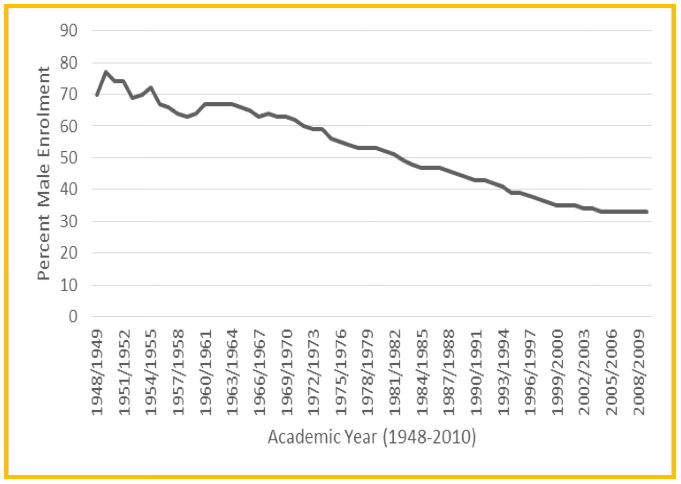
Research by Mark Figueroa and Rhoda Reddock at the University of the West Indies illustrated the changing balance in higher education. In the historical figures presented:
Female enrolments at the Jamaican campus passed 50 per cent by 1974; by 1982, women accounted for more than half of enrolments across all campuses.
By late 1992, women represented 70 per cent of graduates from the Jamaican campus.
By 2007, women accounted for 83 per cent of the student intake in Jamaica, compared with 17 per cent for men.
Connections with the Pacific
Professor Plummer also discussed similar patterns in Samoa. His summary cited a 2023 Ministry of Education, Sports and Culture report describing declining male participation and progression to higher levels of education, and a widening gender gap. The 2019 and 2020 Education Statistical Digests pointed to the need for comprehensive research into the causes of disparities in achievement disadvantaging male students.
He emphasised that these changes were well underway before the advent of social media. He also argued that the available evidence did not support attributing the trend to the ‘feminisation of education’.
The presentation examined research into possible explanations for this social shift and why similar patterns have emerged in diverse locations across the Commonwealth and beyond.
For further information about causes and interventions, contact Honorary Professor David Plummer at david.plummer@anu.edu.au.
About the speaker
David Plummer AM, MA (Chichester), MBBS (Monash), PhD (ANU)
David is a medical graduate with a PhD in health sociology from the National Centre for Epidemiology and Population Health at the Australian National University. His interests include the social determinants of health, health equity and qualitative research methods.
He has worked in the Caribbean, Asia-Pacific, Europe and Africa. At the Royal Tropical Institute in Amsterdam, he specialised in health and international development, contributed to research on health systems strengthening in five African countries and taught in the Master of Public Health programme.
He previously held the inaugural joint Commonwealth/UNESCO Chair at the University of the West Indies. In that role, he developed and led the Caribbean Masculinities Project, collecting and analysing detailed data in eight Caribbean and South American countries. He also served for more than ten years as an Adjunct Professor in Public Health at the University of Texas, Houston.
David was appointed a Member of the Order of Australia in 2003 for services to public and community health. In 2026, the Commonwealth of Learning commissioned him to evaluate gender equality policies at the National University of Samoa, with particular reference to declining enrolment of young Pacific men in higher education.